Key Takeaways
- -Office automation starts with smart schedules for lighting, climate, access, and energy. AI adds a layer that adapts to actual occupancy and behaviour. Conversational AI lets you manage it all in natural language.
- -A mid-sized office (100-300m2) typically costs € 15,000 to € 35,000 to automate. Payback through energy savings is usually 3-5 years.
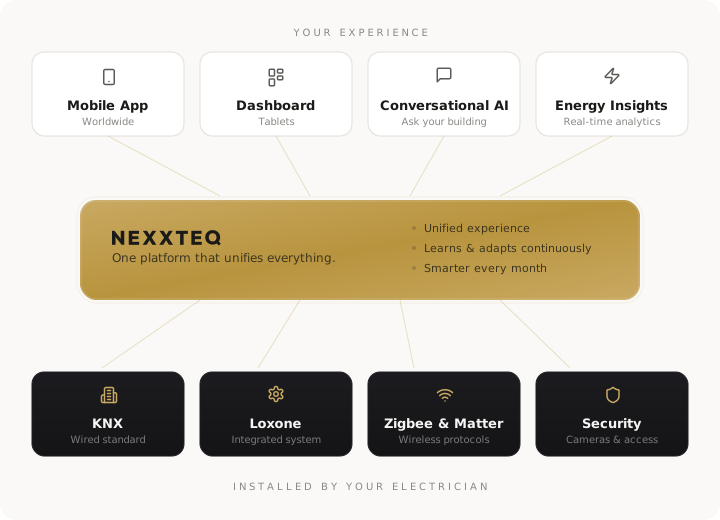
- -The underlying system (KNX, Loxone, wireless) is your electrician's choice. Nexxteq unifies everything into one app, one AI, one experience, regardless of what protocol runs underneath.
- -Without AI, office automation follows rules. With AI, it learns patterns, predicts needs, and optimizes continuously. The difference is 15-30% additional energy savings.
- -Nexxteq adds AI to existing office automation and upgrades continuously. Your office gets smarter every month without hardware changes.
What is office automation?
Office automation starts with smart schedules: lighting, climate, access, and energy systems that follow well-designed rules. The next layer adds sensors and AI that adapt those schedules to actual occupancy and behaviour. The magic layer is conversational AI that lets you manage your space in natural language.
Most offices still run on crude timers. HVAC starts at 7:00 regardless of whether anyone is there. Lighting runs all day, even when daylight is sufficient. Meeting rooms are conditioned for meetings that never happen. Good automation replaces crude timers with smart schedules. Great automation adapts those schedules based on real data: motion sensors detect occupancy, light sensors measure daylight, temperature sensors track climate per zone. AI learns patterns and optimises continuously. And conversational AI means you can ask your building a question or give it an instruction, just like talking to a colleague.
This is not just for large office buildings. A dental practice with two treatment rooms. A hair salon. A coworking floor. A restaurant. Any commercial space where energy is a meaningful cost and comfort matters benefits from automation.
“Office automation is not a luxury. It is infrastructure with measurable returns.”
What can you automate?
More than most people expect.
Lighting. The quickest win. Occupancy-driven lighting (lights off in empty rooms, dimming when daylight is sufficient) saves 30-50% on lighting energy. Cheap to implement, immediately visible. Circadian schedules that shift colour temperature throughout the day improve focus and wellbeing.
HVAC. The biggest win. Climate control accounts for 40-60% of commercial energy costs. Zone-based HVAC that responds to actual occupancy eliminates the largest source of waste: conditioning empty spaces.
Meeting rooms. Sensors detect whether a booked room is actually occupied. No-show? The system releases the room and adjusts the climate. Screens show availability. The room prepares itself for the next meeting.
Security and access. Smart locks, badge systems, cameras, and alarm integration. The building knows who arrived, adjusts their preferred settings, and logs occupancy data that feeds into AI optimization. After-hours intrusion detection ties into lighting and alerting.
Displays and AV. Digital signage, welcome screens, meeting room panels, and projector control. The system can power on a screen when someone enters, show the day's schedule, and shut everything down when the space empties.
Electrical devices. Smart plugs and relays bring control to coffee machines, printers, EV chargers, water heaters, and any device that draws power. Scheduled or occupancy-based switching eliminates phantom loads and unnecessary runtime.
Blinds and shading. Automated based on sun position, interior temperature, and glare detection. Coordinates with HVAC and lighting for maximum efficiency.
Energy monitoring. The data foundation for everything else. Per-circuit monitoring shows exactly where energy goes. Without this data, optimization is guesswork.
What sits underneath does not matter
Most office automation conversations start with protocol choices: KNX, Loxone, wireless, hybrid. That matters for your electrician. It should not matter for your experience.
The point of a well-designed system is that you never think about what protocol the light switch speaks. You interact with one unified platform. You see one app, one dashboard, one conversational AI interface. The underlying technology, whether it is KNX, Loxone, Zigbee, Matter, or a combination, is an implementation detail handled by your installer.
This is the Nexxteq approach. The platform connects to whatever infrastructure your building has or your electrician recommends. KNX for larger spaces. Loxone for smaller setups. Wireless for retrofits. Hybrid for everything in between. It does not matter. Nexxteq unifies them into a single intelligent layer with one experience, one app, and AI that works across all of it.
The practical benefit: you are not locked into one vendor's ecosystem. Your electrician installs what makes sense for the space. Nexxteq makes it smart. If you expand, change, or add devices from different manufacturers, the platform absorbs them without you rebuilding anything.
How much does office automation cost?
Budgets for commercial spaces, including hardware, installation, and basic AI setup.
| Space type | Size | Investment |
|---|---|---|
| Practice or studio | Under 50m2 | € 3,000 - € 8,000 |
| Shop or salon | 50-100m2 | € 5,000 - € 15,000 |
| Mid-sized office | 100-300m2 | € 15,000 - € 35,000 |
| Large office or coworking | 300m2+ | € 30,000 - € 80,000+ |
| Restaurant or gym | 100-500m2 | € 10,000 - € 40,000 |
The ROI in commercial spaces is more concrete than in homes. Energy savings of 20-35%, reduced maintenance costs, and better operational efficiency typically pay back the investment in 3-5 years.
“For an office spending € 5,000 per month on energy, AI-driven automation saves € 750 to € 1,500 per month.”
What does it deliver?
The benefits go beyond energy savings.
Energy savings. 20-35% lower energy costs is realistic for a well-equipped office. Basic automation delivers 20-30%. AI adds another 15-30% by recognizing patterns no human would notice.
Comfort. Spaces that adapt to the people in them. No cold meeting rooms on Monday morning. No tropical temperatures on the top floor in summer. Climate that responds to actual conditions.
Productivity. Research consistently shows that lighting quality and indoor climate affect productivity. Daylight-following lighting and consistent temperatures reduce fatigue and concentration loss.
Property value. An office with professional automation is more attractive to tenants and buyers. Lower operating costs and modern comfort are selling points.
Office automation with AI
Without AI, office automation follows rules. With AI, it learns.
The difference: an office without AI turns off lighting when a sensor detects no movement for 15 minutes. An office with AI learns that the third floor is empty every Friday afternoon and proactively reduces conditioning. It correlates weather forecasts with occupancy patterns to pre-cool before a heat wave, reducing peak energy consumption.
AI improves over time. Every day of data makes predictions more accurate. Seasonal patterns emerge after a year. The system you have today is the least capable version it will ever be.
If you enjoy configuring systems yourself, Home Assistant can orchestrate a commercial setup. The maintenance burden scales with complexity. For everyone else, the question is not which AI tool to bolt on, but which platform was built for this from the ground up.
How Nexxteq makes it work
Nexxteq is not a BMS. It is not a protocol. It is the intelligence layer that connects everything in your office and makes it act as one system.
The platform connects to whatever your electrician installed: KNX, Loxone, wireless devices, or any combination. From your perspective, there is one app, one dashboard, and one conversational AI interface. You do not manage protocols. You manage your space. Ask it why the energy bill spiked last Tuesday. Tell it to prepare the office for a 30-person event on Thursday. It understands, acts, and learns.
What makes this different from traditional building management is that the AI improves continuously. New models, new capabilities, every month. A traditional BMS does what it was programmed to do on installation day, forever. Nexxteq evolves. The system you have in month one is the least capable version it will ever be.
For business owners and facility managers who want to focus on their business instead of their building systems, this is the core value. The AI handles the complexity. Your electrician handles the hardware. You handle your business.
Curious what this would look like for your office? We are happy to walk you through what makes sense for your specific situation.
Is office automation right for you?
Yes, if you run a commercial space where energy is a meaningful cost. Offices, coworking spaces, restaurants, gyms, shops, salons, practices. Especially yes if you are renovating or fitting out, because wiring now is dramatically cheaper than retrofitting later.
No, if you run a one-person office with minimal energy costs. A smart plug and a timer deliver most of the benefit for € 50. Also no if you expect a quick plug-and-play solution for a complex building. Office automation requires planning and proper infrastructure.
The Nexxteq angle: for spaces in the "yes" category, Nexxteq adds the AI layer that transforms basic automation into real intelligence. The platform supports KNX, Loxone, and wireless setups, and upgrades continuously as AI evolves. Your office does not just become smart. It gets smarter every month.